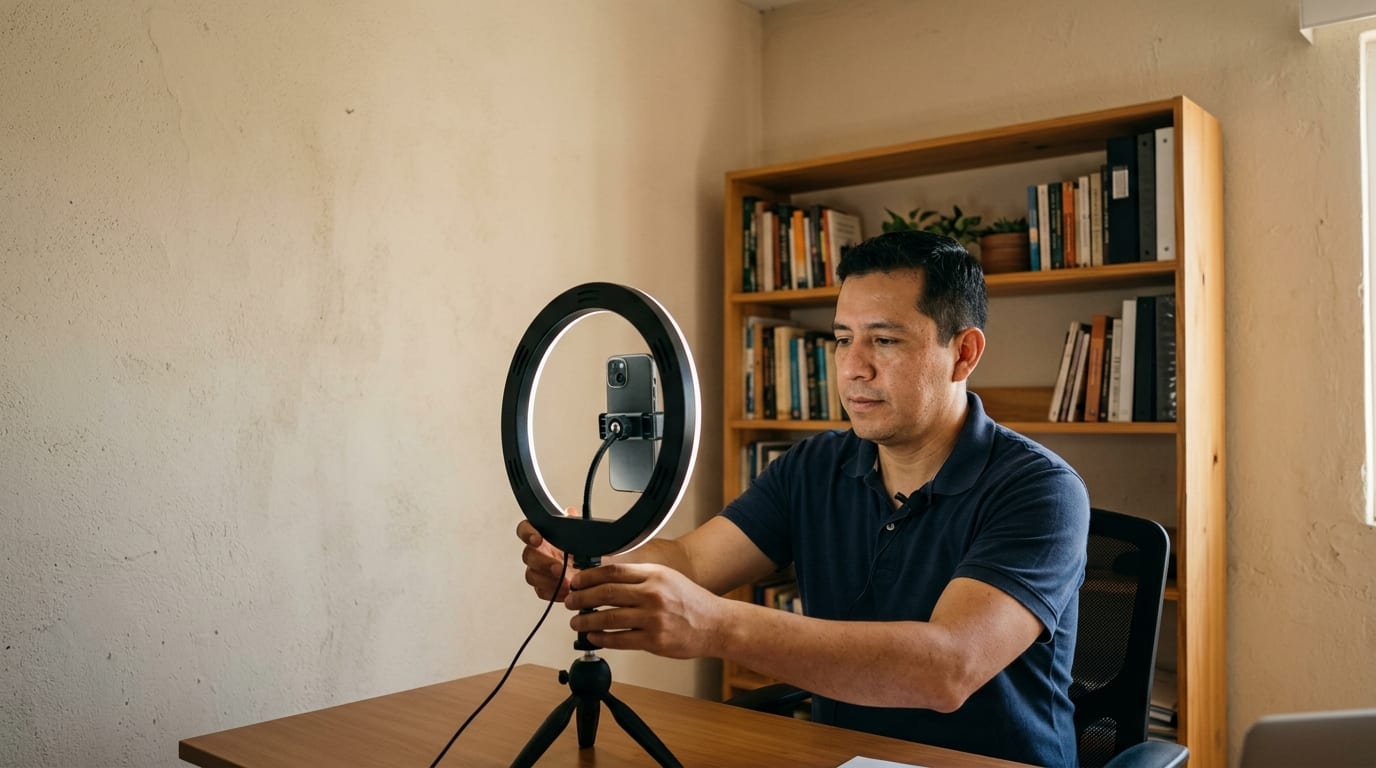
Most financial advisors do not need a professional studio to start a YouTube channel. The baseline is clean audio, adequate lighting, and a stable camera – and all three can be met with equipment you may already own or can purchase for a few hundred dollars. What holds most advisors back is not a gear problem. It is the belief that production quality is the gating factor, when the real gating factor is being on camera at all.
The evidence for this is not theoretical. Andy Panko, CFP®, built Tenon Financial's content ecosystem with a deliberately low-production setup – talking-head videos from a home office, casual attire, substance over visual polish – and that content engine fuels a steady prospect flow into a flat-fee firm founded in 2019 that has grown to $323 million in assets under management across 105 client households, with a little over $3 million average AUM per household (Kitces Financial Advisor Success Podcast, Ep. 479, March 11, 2026). His YouTube channel, Retirement Planning Education, holds 247 videos and 28,600 subscribers (August 2026) – modest numbers by creator standards, attached to a practice most advisors would trade for. The lesson is not that production quality is irrelevant. It is that production quality is not a substitute for a credible human in frame.
Does Audio or Video Quality Matter More for Viewer Retention?
In our experience, audio quality matters more than video quality for keeping viewers watching. A video shot on a smartphone with clear, consistent sound will hold viewers longer than a beautifully lit scene where background noise, echo, or a muffled microphone pulls their attention away from what you are saying.
The reason is simple: viewers will tolerate imperfect visuals if the content is worth their time, but they will leave within seconds if the audio is hard to follow. For a financial advisor, where the value is in the explanation – the subtlety around a Roth conversion, the logic behind a withdrawal sequence – poor audio destroys the very thing that makes the video worth watching.
The practical implication: spend your first equipment dollar on a microphone, not a camera. A USB condenser microphone or a lavalier mic clipped to your lapel will do more for your channel's new-viewer retention than upgrading from a smartphone to a mirrorless camera. New-viewer retention – how long someone who has never seen your content before stays with a video – is one of the clearest early signals of whether YouTube's algorithms will keep showing that video to more new people. Retention is a proxy for viewer satisfaction, not the whole picture, but it is the part that production quality touches most directly. Blended retention numbers mix new and returning viewers and can mask the fact that new prospects are leaving early.
What Lighting Setup Does a Financial Advisor Actually Need?
Lighting is the single fastest visual upgrade most advisors can make, and it requires almost no technical knowledge to get right. A single key light – either a ring light or a softbox – positioned in front of you and slightly to one side will eliminate the flat, shadowy look that makes a home office setup read as amateur.
The goal is not cinematic lighting. The goal is to look credible: a well-lit face in a tidy, professional-looking space signals that you take this seriously, which transfers to how prospects perceive your judgment as an advisor. A cluttered background, a window behind you blowing out the image, or a single overhead light casting harsh shadows undercuts that credibility before you say a word.
Natural light from a window in front of you – not behind you – is free and often sufficient. If your content creation space has inconsistent light through the day, a ring light in the $50 – $150 range gives you consistent results regardless of time or season. That is the entire lighting budget many advisors need to start.
What Camera Do Financial Advisors Need to Start on YouTube?
The camera you already own is likely sufficient to start. Modern smartphones – including models that are two or three years old – shoot video at a resolution that looks professional on YouTube when combined with good lighting and clean audio. You do not need a mirrorless camera, a DSLR, or any dedicated video equipment to publish your first videos.
The comparison that matters is not "smartphone vs. professional camera." It is "good lighting and audio with a smartphone" vs. "no lighting and poor audio with an expensive camera." The former wins every time.
| Setup | Audio | Lighting | Camera | Viewer Experience |
|---|---|---|---|---|
| Smartphone, no accessories | Built-in mic (variable) | Available light (variable) | Adequate | Inconsistent – audio/lighting gaps hurt credibility |
| Smartphone + lapel mic + ring light | Clear, consistent | Controlled | Adequate | Professional enough to not distract |
| Dedicated camera + USB mic + softbox | Clear, consistent | Controlled | High quality | Incremental improvement over middle tier |
The key takeaway: the middle tier – a smartphone with a $30 – $80 lapel mic and a basic ring light – is where most advisors should start, and many will find it sufficient for years. The upgrade to a dedicated camera is incremental, not transformational.
How Much Production Polish Does a Financial Advisor's YouTube Channel Actually Need?
Production quality should be good enough that it does not distract from the content. That is the entire standard. It is not a substitute for strong topics, clear structure, and on-camera trust – which are the things that make a viewer book a call or subscribe for more.
YouTube's algorithms – the separate systems running Browse, Suggested, Search, and Shorts – distribute content based on how viewers respond to it: whether they click, whether they stay, whether they come back. None of those signals are responses to production quality in isolation. They are responses to whether the content answered a real question in a way that felt trustworthy and worth the time.
This is why the inauthentic-content lane that used to compete with advisor channels – synthetic voiceovers, stock footage, no human in frame – has been losing ground under YouTube's evolving monetization policies. The templated channel was always the shortcut that promised YouTube for financial advisors authority without the on-camera commitment. The platform's enforcement is now pointing the same direction the audience always pointed: toward the real human expert.
For a financial advisor YouTube video structure to do its job, the advisor needs to be on camera, speaking clearly, in a space that looks intentional. That is the production standard. Everything beyond it is optional improvement.
What Is the Biggest Production Mistake Financial Advisors Make?
Waiting for perfect production conditions is one of the most common reasons financial advisors delay launching a channel – and it is the most expensive mistake in terms of compounding opportunity cost.
The advisors who are building YouTube authority right now are not waiting. According to Broadridge's third-annual financial advisor marketing survey (October 2021), among advisors who had obtained a new client through social media, only 3% reported obtaining a lead on YouTube – versus 71% on LinkedIn. That number reflects how early this still is. Your competitors are starting channels right now, and the ones who build a library of credible videos on the topics their ideal clients care about will have a head start that later entrants have to earn from zero.
A channel that publishes on a modest setup and improves over time beats a channel that never starts. The equipment question has a clear, low-cost answer. The harder question – and the one that actually determines outcomes – is whether you are willing to be on camera and say something useful.
How Do You Keep Production Manageable Without Sacrificing Quality?
The production burden is real, and advisors who try to handle editing, optimization, and post-production themselves often find it consumes far more time than the creation itself. That is where a done-for-you production system changes the math.
Every YT Era engagement is built around five hours a month of the advisor's time – one content creation session and one strategy call. We handle strategy, production, publishing, optimization, and prepare everything for your compliance review. The equipment the advisor uses matters far less than the system around it: topics chosen for the right audience, videos structured to hold new viewers, thumbnails and titles built to earn clicks, and a publishing workflow that does not require the advisor to become a video editor.
The question of what camera or microphone to buy is answerable in an afternoon. The question of how to build a channel that compounds into a qualified-lead pipeline – that is what building a YouTube channel that attracts ideal clients actually requires.
So, What Equipment Does a Financial Advisor Actually Need to Start a YouTube Channel?
A financial advisor needs three things to start a YouTube channel: clean audio, adequate lighting, and a stable camera. All three can be met with modest equipment – in many cases, equipment already on hand. Audio is the priority investment. Lighting is the fastest visual upgrade. The camera is the last thing to upgrade.
What no equipment purchase can substitute for is being on camera, being consistent, and producing content that answers the questions your ideal clients are actually asking. According to Wealthtender's 2025 Study of $100K+ Households Seeking Financial Advice, 96% will do further research online before making a hiring decision. When they search, what they find – or do not find – is the outcome this channel is built to change.
If you are weighing how to get started and want a clear picture of what to look for in a YouTube partner, the Financial Professional's Guide to Picking a Great YouTube Marketer walks through exactly what to evaluate before committing to any production approach.
Reach out at hello@ytera.com to talk through whether a done-for-you YouTube channel makes sense for your practice.
Written by Andrew Murdoch, Chief YouTube Officer
Checklist
-
Prioritize audio first. Before buying any other equipment, get a USB condenser microphone or a lapel mic. Clean audio is the production element that does the most to keep new viewers watching.
-
Test your existing camera before buying a new one. Create a short clip with your current smartphone in good light and evaluate the result. Most advisors find their phone is sufficient to start a financial advisor YouTube channel.
-
Control your light source. Position a window in front of you, not behind you. If your room's natural light is inconsistent, a ring light in the $50 – $150 range gives you reliable results every session.
-
Declutter your background. A tidy, intentional space – a bookshelf, a neutral wall, a plant – signals professionalism before you say a word. Your content creation environment is part of your on-camera trust.
-
Create a test video before investing in upgrades. Watch it back with headphones. The problems you notice – usually audio or lighting – tell you exactly where to spend next.
-
Build a production system, not just a setup. Equipment gets you in front of the camera. A repeatable workflow – topics, structure, publishing, optimization – is what turns on-camera sessions into compounding lead-generation assets.
FAQ
What microphone should a financial advisor use for YouTube?
A USB condenser microphone or a lapel (lavalier) microphone clipped to your lapel are both solid starting points. The USB condenser sits on your desk and picks up your voice clearly without requiring any audio interface. The lapel mic is more portable and stays consistent if you move while talking. Either option will deliver dramatically cleaner audio than a built-in laptop or smartphone microphone, and clean audio is the production element that most directly affects whether new viewers stay with your video.
Which is better for a financial advisor starting on YouTube – a ring light or a softbox?
Both work well, and the choice depends mostly on your space. A ring light is compact, easy to position, and produces a consistent, flattering light that works in most home office setups. A softbox spreads light more naturally and reduces the circular catchlight reflection in glasses – a common issue for advisors who wear them. For most advisors starting out, a ring light is the faster, simpler choice. Either option in the $50 – $150 range is sufficient to look professional on camera.
Do financial advisors need to upgrade their camera before launching a YouTube channel?
No. A smartphone that is two or three years old shoots video at a resolution that looks professional on YouTube when paired with good lighting and clean audio. The upgrade from a smartphone to a dedicated mirrorless camera is incremental, not transformational – and it is the last equipment upgrade worth making, not the first. Most advisors who delay launching because they are waiting to afford a better camera are solving the wrong problem.
Who has built a successful financial advisor YouTube channel without a professional studio?
Andy Panko at Tenon Financial is a clear example. His Retirement Planning Education channel is deliberately unpolished – a home office setup, casual attire, no production crew, self-produced with minimal equipment – and it is one pillar of a content ecosystem that feeds a flat-fee firm managing $323 million across 105 client households (Kitces Financial Advisor Success Podcast, Ep. 479, March 11, 2026). The channel's pull came from substantive content delivered by a credible human on camera, not from production quality. That pattern holds broadly: the on-camera trust is the asset, not the equipment.
How much does it cost to set up a YouTube content creation space for a financial advisor?
The cost drivers are the microphone, the light, and any camera upgrade. A lapel mic runs roughly $30 – $80; a ring light, $50 – $150; a USB condenser microphone, $80 – $150. An advisor starting with a current smartphone needs to spend no more than $150 – $250 total to have a setup that meets the production standard: clean audio, controlled light, stable framing. A dedicated camera is an optional upgrade that can come later, once the channel is producing content consistently.
What is the real reason most financial advisors delay starting a YouTube channel?
Equipment is the stated reason. The real reason is usually discomfort with being on camera. Waiting for a better microphone or a cleaner background is a socially acceptable way to delay a decision that is actually about on-camera confidence. The advisors who build YouTube authority are the ones who create something imperfect and publish it anyway, then improve from there. The production setup can be upgraded at any time. The months of accumulated videos, viewer data, and audience that come from starting earlier cannot be bought back later.
Where should a financial advisor create YouTube videos if they don't have a dedicated office?
Any quiet room with a controllable light source works. The priorities are: minimal background noise (close doors, turn off HVAC if possible), a light source in front of you rather than behind you, and a background that looks intentional rather than accidental. A bookshelf, a neutral wall with a plant, or a simple backdrop panel all read as professional. The location matters far less than the light and audio conditions within it – a spare bedroom with a ring light and a lapel mic will outperform a messy office with expensive equipment every time.