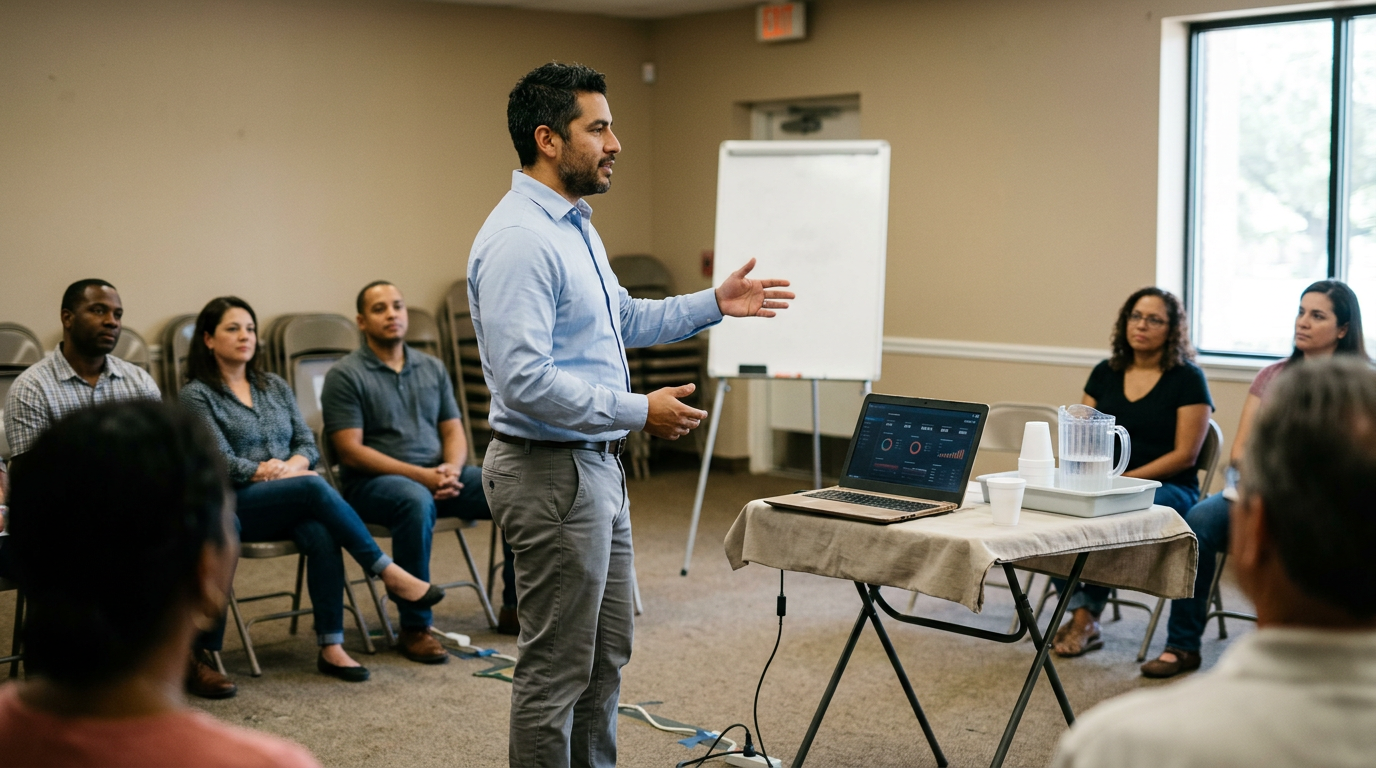
Major consumer brands are spending enormous sums to manufacture something financial advisors have had for decades: a room full of people who showed up. The answer to whether your YouTube channel should connect to your seminar business is yes, and the reason most advisor channels underperform has nothing to do with content quality. It has to do with design. The two halves of a complete marketing system are already running inside most advisory firms. They just aren't wired together.
Why Are Brands Opening Cafés and What Does That Have to Do With You?
Marketing is splitting into two extremes. On one end: AI-scale digital, where content is cheap, fast, and everywhere. On the other: extreme analog, physical, human, in-the-room experiences that no algorithm can replicate.
The middle is dying.
What does the analog end look like right now? One major credit card company operates roughly 65 cafés, not to sell financial products, but to create the experience of being in a room with the brand. A global fashion house opened cafés starting in 2024. A luxury jewelry brand runs a well-known café as a brand touchpoint. A luxury apparel company has operated more than 40 cafés globally since 2014.
Read that list again. A handbag company is using coffee as a loyalty play. A credit card company is competing on hospitality. These are billion-dollar businesses spending at scale to manufacture the experience of being in a room with a human being.
Advisors have had that the entire time.
Client appreciation dinners. Medicare workshops. Shred days. Estate planning lunch-and-learns. Chamber events. Referral lunches. The annual review across a desk. Consumer brands are spending eight figures to fake what a Medicare workshop produces for the cost of sandwiches.
The seminar business isn't old-fashioned. Under this frame, it's the scarce end of the barbell. As AI floods every digital surface with content, the room becomes the rare thing, and rare is where value goes. Advisors aren't behind on analog. They're holding one end of a barbell and wondering why it feels unbalanced.
What Is a Financial Advisor YouTube Channel Actually For?
No advisor wants to be a YouTuber. What they want is trust at scale, the thing a large, credible channel produces.
Define it concretely: a stranger arrives at the discovery call having already spent hours with you, already believing you, already pre-sold — pre-qualified and pre-sold before you've spent a minute of your time. That's the product. The channel is a trust machine, not a media property.
The mismatch that causes most YouTube marketing for financial advisors failures is this: advisors take advice built for creators whose business model is advertising revenue, where views are the product. For an advisor, views are an input cost. Right playbook, wrong sport.
The channel's job is not to convert. It's to filter. Two things happen on the channel and nowhere else: the right people identify themselves by watching, and a subset of them raise a hand to take a next step. Qualification — verifying who can actually become a client — happens after they leave YouTube, and conversion happens somewhere else entirely: in the seminar, the consultation, the discovery call. Across every documented advisor channel with real business outcomes, the pattern holds. The channel gets the right people to that room. It doesn't close them, and it doesn't try to.
What Is the Loop and How Does It Work?
The loop is three legs. Room → YouTube channel → room. Name it that and it survives being retold.
Where Do the Questions Come From?
Every workshop, every dinner, every Q&A surfaces the same four or five questions, in the prospect's own words, with the fear still attached. That is demand data you cannot buy, cannot survey your way into, and cannot generate synthetically. It's the highest-fidelity audience research available in the industry, and it's already happening in rooms you're already paying for.
Most advisor content answers questions advisors find interesting: portfolio construction, tax-loss harvesting mechanics, market commentary. The room tells you what clients find urgent, which is almost never the same thing.
What to capture isn't the presentation. It's the questions, who asked, what they actually said, what they were afraid of underneath the question. What to produce isn't a recap video. It's a topic pipeline. One workshop can yield a quarter's worth of evergreen content.
The room is where you learn what to say. YouTube is where you say it to everyone else who has the same question and nobody to ask.
How Does the Channel Answer at Scale and Sort Prospects?
The same question that got asked by six people in a room gets asked by hundreds or thousands of people typing it into a search bar. The video does the work the seminar does, except it does it continuously, nationally, and without catering.
What it produces is not clients, and not yet qualified prospects. It's the right strangers: people who have self-selected by watching forty minutes of a specific answer to a specific problem they have. They still have to clear your intake before a call gets booked — that's where qualification actually happens — but they arrive there, and later at the discovery call, differently than a cold referral does.
How Does the Room Distribute the Channel?
This is the leg almost nobody accounts for, and it runs backward through the same room.
Advisors send specific videos to specific people: after a meeting, before an annual review, in response to a client question, to a referral source, to a center of influence who asked what the firm thinks about Roth conversions. That distribution never touches the recommendation system. It doesn't show up as algorithmic reach. It's often the most valuable traffic on the channel, and the analytics barely register it.
Advisors already understand this instinctively, because referral has always been how advisory firms grow. The video is simply a referral asset that scales, the answer you'd give at lunch, deliverable to anyone, forever.
Why Does the Funnel Break Down in Most Firms?
The problem in most firms isn't a missing funnel. It's an undesigned one, a channel and a seminar business running inside the same firm with no deliberate connection between them.
The concrete tells: videos with no call to action pointing at the event. Each of those is a broken filter at a different stage — the video that doesn't sort, the event that doesn't get distributed, the handoff that never qualifies — and a broken stage anywhere leaks the whole system. Events that never mention the channel. Nobody sending videos to prospects between meetings. No tracking of which video preceded which booked call.
Across the documented advisor channels with real business outcomes, a consistent pattern holds: closing does not happen on YouTube. The observed machinery is two-part seminars and bundled consultations, webinar-to-discovery-call funnels, downloadable guides feeding consultation requests, in-person seminars sitting directly downstream of the channel. The advisors who are winning are already running the barbell. They just built it deliberately.
The fix is not more content. It's wiring what already exists.
What Not to Create
Your first instinct might be "so I should film my events." That doesn't work.
Advisor channels built on live-show recordings, webinar uploads, and long-form livestreams underperform badly on discoverability. One documented channel published nearly 1,500 videos of this type to an average of a few hundred views with no attributable business result. Another deleted more than 550 livestream recordings as part of a repositioning.
The reason is structural: an event is built for the people in the room. Its pacing, its in-jokes, its unreadable slides and house audio all assume presence. Stripped of that context, it's a recording of something you weren't at.
Stage footage and conference clips can work as proof inside other content, as a trailer, a cutaway, a credibility signal. Not as programming.
Capture the ideas. Don't publish the room.
How Do You Build the Loop Deliberately?
The last decade trained everyone to build for the feed. The next decade rewards the people who build for the room, and then broadcast what happens there.
Advisors don't need to become influencers. They need to stop running the two halves of their business as if they were separate businesses. The room and the channel are the same business. One generates the questions; the other answers them at scale; the first one distributes the answers.
There's also a longer-term argument worth naming: content has been cited explicitly in RIA acquisition and investment rationale. A channel built on this loop isn't a marketing expense, it's an asset that can show up in a valuation. That's a different conversation than "should I post more videos."
Getting the compliance side right is part of making this work. Understanding YouTube compliance approval for RIA owners is a practical early step, it removes the friction that keeps most advisor channels from publishing consistently.
Building the loop is what YT Era's work is designed to support: connecting the channel to the business it's supposed to serve, not running it as a separate initiative. If you want to understand the framework in more depth, Mastering YouTube Marketing for Financial Services lays out the full methodology. To talk through whether this applies to your practice, reach out at hello@ytera.com.
Checklist
-
Map your existing events to content: After your next workshop or seminar, write down the five questions that came up most, those are your next five video topics.
-
Audit your channel for the loop: Check whether your videos include a clear next step pointing toward your events, consultations, or discovery call process.
-
Build a direct-distribution habit: Identify three situations where you already send information to clients or prospects, and test sending a relevant video instead of, or alongside, a written explanation.
-
Stop uploading event recordings as standalone content: If your channel has webinar recordings or livestream uploads with low views, consider whether they're helping discoverability or diluting it.
-
Track the connection: Note which video a prospect watched before they booked. Even informal tracking reveals whether the channel is qualifying the right people.
-
For financial advisors running seminar businesses: Treat your event Q&A as a content brief, not just a closing opportunity, the questions your audience asks in person are the questions thousands of others are searching for online.
FAQ
Do financial advisors actually get clients from YouTube, or does it just build brand awareness?
Based on documented advisor channels with real business outcomes, YouTube rarely closes clients directly. What it does is qualify them, prospects arrive at discovery calls having already spent significant time with the advisor's thinking, which changes the nature of that conversation. The closing happens in the seminar, the consultation, or the call. The channel's job is to make sure the right people show up to those.
Should I film my seminars and workshops and post them on YouTube?
Filming the room and publishing it as-is consistently underperforms. One documented advisor channel published nearly 1,500 event recording videos to an average of a few hundred views with no attributable business result. Another deleted more than 550 livestream recordings during a repositioning. Events are built for the people in the room, the pacing, audio, and context don't translate to a viewer who wasn't there. Use the ideas from events to create purpose-built videos; use stage or event footage as credibility packaging inside other content.
What kind of content should a financial advisor actually put on YouTube?
Start with the questions your seminar and workshop audiences ask most urgently, not the topics you find technically interesting. The questions clients ask in a room, with their actual fear attached, are almost always different from what advisors assume they want to hear. Portfolio construction and market commentary are common advisor instincts; retirement income sequencing, Social Security timing, and "what happens if my spouse dies first" are what rooms actually surface.
How does YouTube fit with a referral-based advisory practice?
YouTube extends how referrals already work. When a center of influence or existing client wants to explain why they trust an advisor, a video library gives them something concrete to share. Advisors who send specific videos, after a meeting, before an annual review, in response to a question, are using the channel as a referral asset. That distribution doesn't show up as algorithmic reach, but it's often the most commercially valuable traffic on the channel.
How long does it take for a financial advisor's YouTube channel to start producing results?
YouTube requires consistent publishing over an extended period before the channel builds enough trust and discoverability to qualify prospects at scale. There's no reliable timeline, and anyone offering one is guessing. What matters more than timeline is whether the channel is built on the right questions, connected to the right next step, and publishing consistently enough for the algorithms to understand what it's about.
What's the biggest mistake advisors make when they try to connect YouTube to their seminar business?
The most common failure is running both as separate initiatives with no deliberate connection, videos that don't point to events, events that don't mention the channel, no process for sending relevant videos to prospects between touchpoints. The fix isn't more content; it's wiring what already exists. Most firms are closer to a working system than they think. The missing piece is design, not effort.
Does YouTube channel content have any value beyond marketing?
Content has been cited explicitly in RIA acquisition and investment rationale. A channel built on a genuine content strategy isn't just a marketing expense, it can function as a business asset that shows up in a valuation conversation. That's a longer-term argument, but it changes how to think about the time and resources going into it.