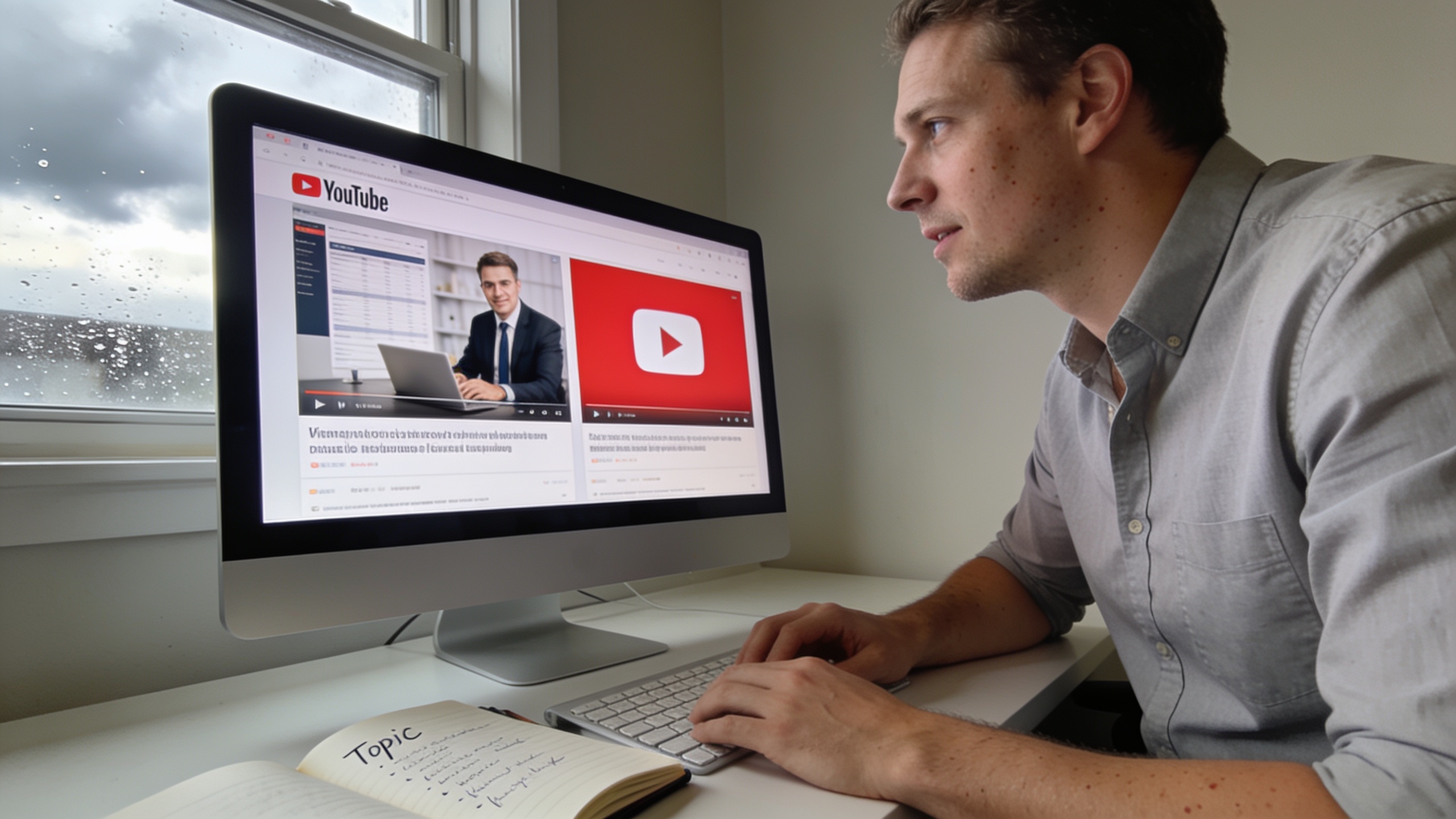
Your financial advisor YouTube channel isn’t getting new viewers because it’s optimized for people who already know you — not for strangers who’ve never heard of you. That’s the real problem most advisors face, and it has nothing to do with posting frequency or video quality. Growing a YouTube channel for financial advisors requires three distinct skills: picking topics new viewers actually care about, creating titles and thumbnails that stop the scroll, and delivering on the promise of your title in the first 15 seconds.
Are You Actually Solving the Right Problem?
Most financial advisors who feel stuck on YouTube are solving the wrong problem. They assume they need better equipment, more consistent uploads, or a slicker editing style. Those things don’t move the needle if the underlying issue is that every video is aimed at people who already follow you.
After producing 1,700+ videos for financial professionals, the pattern is consistent: returning viewers aren’t the problem. They’ve already consumed your content. They know, like, and trust you. Adding value to people who already trust you is something every competent advisor does every day — it’s not a growth lever, it’s just good practice.
The real growth lever is capturing attention from people who’ve never heard of you. That’s the entire game on YouTube. Channels that are growing right now are serving both audiences — the returning viewers who already trust them, and the strangers who are encountering them for the first time. Most stalled channels are only doing the first half.
What Three Skills Do You Actually Need to Attract New Viewers?
Attracting new viewers on YouTube — specifically for YouTube for Financial Advisors — comes down to three skills, applied in order. Skipping ahead doesn’t work.
1. Pick Topics New Viewers Actually Care About
The topics that connect with your existing clients are often too narrow or too assumed for a cold audience. A returning viewer already understands your philosophy and your niche. A new viewer is typing a question into YouTube’s search bar or scrolling a feed — they’re looking for something that speaks directly to a problem they have right now.
Topic selection for new viewers means thinking like a stranger, not like a trusted advisor. What would someone search for before they ever knew your name? That’s the entry point.
2. Create Titles and Thumbnails That Stop the Scroll
A new viewer has no loyalty to you. They’re making a split-second decision based entirely on what they see before they click. Your title and thumbnail are the only tools you have at that moment.
This doesn’t mean sensationalism. It means clarity and relevance. The title needs to signal, immediately, that this video answers something the viewer cares about. The thumbnail reinforces that signal visually. When both are working together, the click happens.
3. Deliver on the Promise in the First 15 Seconds
This is the most critical skill of the three, and the one most advisors underestimate. If a new viewer clicks your video and the payoff doesn’t arrive until minute 12, they’re gone by minute 1. Not because they’re impatient — because you didn’t deliver what you promised.
Clickbait isn’t a bold title. Clickbait is a broken promise. A strong title that leads to a slow, meandering intro is still clickbait — just a polite version of it. The first 15 seconds need to confirm that the viewer clicked the right video.
Why Do Returning Viewers Keep Watching While New Viewers Leave?
The difference in behavior between returning viewers and new viewers is almost entirely about trust. Returning viewers have already built a relationship with you through your content. They’ll tolerate a slow start, an off-topic tangent, or a format they’re not wild about — because they already like you.
New viewers have none of that goodwill. They arrived from a title or a thumbnail that made a specific promise. If the first 15 seconds don’t confirm that promise, they click away. YouTube’s algorithm reads that as a signal that your video isn’t worth recommending — and it stops pushing it to new people.
This is why the same video can perform completely differently with two audiences. A returning viewer watches through to the end. A new viewer leaves in the first minute. The video didn’t change — the context did. Understanding this dynamic is what separates advisors who grow their channel from advisors who plateau.
What Does a Channel That Serves Both Audiences Look Like?
A channel that attracts new viewers while retaining returning ones isn’t built on luck or volume — it’s built on intentional structure. Every video has a clear topic that a stranger could care about, a title and thumbnail that communicate that topic immediately, and an opening that confirms the promise before the viewer has a reason to leave.
The financial advisors whose channels are growing right now have internalized this. They’re not making videos for their current clients. They’re making videos that their current clients happen to also enjoy — because good content for a new viewer is usually good content for everyone.
This is also where most DIY channel management falls apart. Advisors are excellent at the subject matter. They’re often less practiced at the specific craft of new-viewer acquisition: topic research, thumbnail design, and opening hooks that land in the first 15 seconds. That’s the gap our YouTube channel management service for financial advisors is built to close — not by replacing the advisor’s voice, but by handling the structural work that determines whether new viewers ever show up in the first place.
Summary: The New-Viewer Problem Is Solvable
Stalled growth on a financial advisor YouTube channel almost always traces back to the same root cause: the channel is built for people who already know the advisor, not for people who don’t. Returning viewers are easy — they already trust you. New viewers require a different approach entirely.
Three things need to work in sequence: the topic has to matter to a stranger, the title and thumbnail have to earn the click, and the first 15 seconds have to confirm the viewer made the right choice. When all three are working, the channel grows. When any one of them is missing, new viewers don’t arrive — or they arrive and leave immediately.
If you want to go deeper on how YouTube actually works for financial professionals, Mastering YouTube Marketing for Financial Services covers the full framework in plain language.
To get started with YT Era, Apply to work with us and we’ll assess whether your channel is a fit.
Checklist
- Audit your last 10 video topics — would a complete stranger searching YouTube care about any of them, or are they written for people who already follow you?
- Review your titles and thumbnails as a cold viewer — open an incognito browser, find your channel, and ask: would you click on any of these if you didn’t know the advisor?
- Time your own opening — watch your last video and note exactly when the promised value first appears. If it’s past the 60-second mark, that’s the fix.
- Separate your audience strategy — identify which videos on your financial advisor YouTube channel are designed for returning viewers and which are designed to attract new ones. Both should exist.
- Use a Viewer Avatar Template — before scripting your next video, define who the new viewer is: what they’re searching for, what they’re worried about, and what would make them stay.
- Check your click-through rate and average view duration together — high CTR with low retention means your title is working but your opening isn’t. Low CTR means the title or thumbnail isn’t earning the click.
FAQ
Why does my financial advisor YouTube channel keep getting views from existing subscribers but not new people?
When a channel consistently attracts returning viewers but not new ones, it usually means the content is optimized for people who already know the advisor — familiar topics, assumed context, and openings that make sense if you’ve watched before. New viewers need a different entry point: topics framed around questions they’re already asking, titles that communicate value immediately, and an opening that confirms they clicked the right video.
What does “delivering on the promise in the first 15 seconds” actually mean?
It means the viewer who clicked your video based on the title should hear or see confirmation of that topic within the first 15 seconds — not a lengthy intro, not a channel overview, not a slow build. If your title promises “how to reduce taxes in retirement” and the first 60 seconds are about who you are and what your firm does, new viewers will leave before the actual content begins. The first 15 seconds are a trust signal, not a warm-up.
Is clickbait actually a problem for financial advisors on YouTube?
Clickbait is less about bold titles and more about broken promises. A financial advisor who writes a compelling title and then doesn’t deliver that content clearly and quickly is creating clickbait — even if the title itself is accurate. The fix isn’t to write weaker titles; it’s to make the opening match the promise the title made.
How many videos does it take before a financial advisor YouTube channel starts attracting new viewers consistently?
There’s no fixed number, because volume alone doesn’t solve the new-viewer problem. A channel with 200 videos that are all aimed at existing clients will not attract new viewers reliably. A channel with 30 videos that consistently picks searchable topics, earns the click with strong titles and thumbnails, and delivers on the promise in the first 15 seconds will attract new viewers much sooner. The structure of each video matters more than the total count.
What’s the difference between a topic that works for returning viewers and one that works for new viewers?
Returning viewers will watch content that builds on what they already know about you — deeper dives, follow-up questions, your opinions on current events. New viewers need a topic that stands completely on its own: something they’d search for before they ever knew your name. Think about the questions your ideal client had before they became your client. Those are the new-viewer topics.
Do YouTube’s algorithms treat new viewers differently from returning subscribers?
YouTube’s algorithms pay close attention to how new viewers behave. If a video gets shown to people who don’t subscribe and those viewers leave quickly, the algorithms reads that as a signal to stop recommending the video. Strong click-through rate combined with strong retention — especially in the first 30 seconds — tells the algorithms this video is worth showing to more new people. Returning subscribers are more forgiving; the algorithms uses new-viewer behavior as the real signal for reach.
Can a financial advisor manage YouTube new-viewer growth on their own?
Some can, but the specific skills involved — topic research for cold audiences, thumbnail design, and opening hooks — are different from the skills advisors use every day. Subject-matter expertise doesn’t automatically transfer to new-viewer acquisition. Advisors who grow their channels either develop these skills deliberately over time or work with a team that specializes in them, such as a YouTube channel management service for financial advisors.
If your channel feels like it’s talking to the same 200 people every week and never breaking through to new audiences, the issue is almost certainly structural, not cosmetic. You don’t need more videos. You need the right framework for the ones you’re already making. Reach out to YT Era at hello@ytera.com to start the conversation.