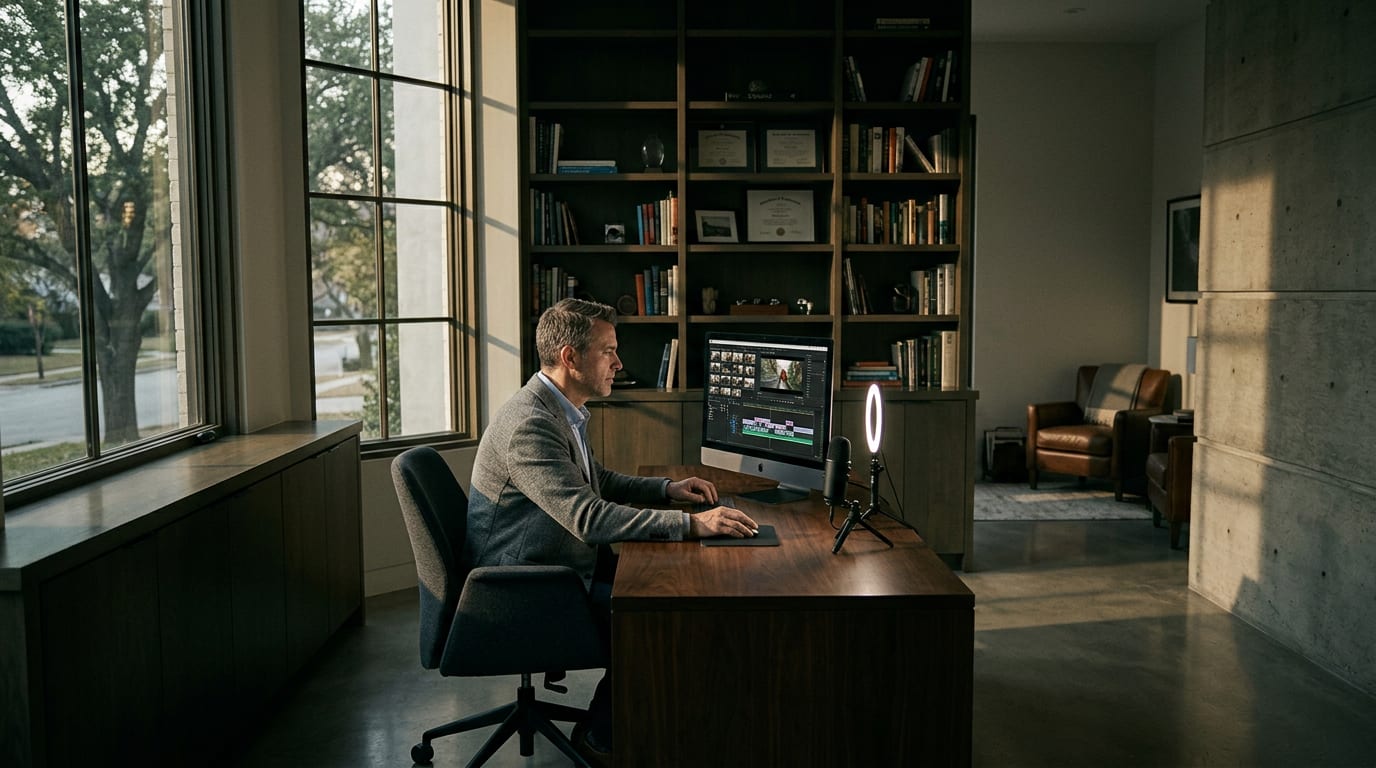
Managing a YouTube channel yourself as a financial advisor is possible, but the honest answer is that many advisors who try it underestimate what the work actually involves. The camera time is a small fraction of the total. Strategy, scripting, editing, thumbnail creation, upload optimization, and compliance review each take meaningful time – and they compete directly with client-facing hours. YT Era works with advisors who have already tried the DIY path and hit that wall, which is why this breakdown exists: to help you decide with accurate information.
What Does Managing a YouTube Channel Actually Require Each Week?
Running a channel is not one task – it is seven distinct disciplines, and each one demands real time.
● Topic strategy and research. Before any on-camera work happens, you need to know which questions your target audience is searching for, which topics have distribution potential across YouTube's surfaces (Browse, Suggested, and Search appear to weight content differently), and how to build coherence across videos over time. Topic coherence tends to matter more than upload volume: 40 videos on one focused subject tend to reach more of the right viewers than 40 videos spread across unrelated themes. Expect one to two hours per week.
● Scripting or outlining. A video without a clear structure loses viewers early.
● On-camera time. The part many advisors think about first. A 10-minute video might take 30 minutes on camera once you are comfortable – or two hours when you are not. Early in a channel, the on-camera work takes longer than it will later.
● Editing. This is where DIY channels stall. Editing a single video to a professional standard – cuts, color correction, lower thirds, captions, intro and outro – takes three to five hours for someone without a production background. In my experience, offloading editing alone meaningfully changes an advisor's ability to sustain a channel, though it does not remove the rest of the workload.
● Thumbnail creation. Thumbnails drive click-through rates. A weak thumbnail can suppress distribution regardless of video quality. Designing one well takes 30 to 60 minutes if you know what you are doing, longer if you do not.
● Upload optimization. Title, description, tags, end screens, cards, chapters, and category selection can affect how YouTube surfaces a video. Doing this well requires understanding how each surface works and what signals each one responds to. Budget 30 to 60 minutes per upload.
● Compliance review. This one belongs entirely to your firm. No YouTube partner can perform compliance review for you – that responsibility stays with your broker-dealer or RIA compliance department. Building your firm's review step into the workflow before every upload is not optional; it is the process. The SEC's 2012 risk alert on investment adviser use of social media lists factors advisers should weigh when evaluating their compliance program, including approval of content and recordkeeping.
Add it up and a single video, done properly, runs a meaningful number of hours – before the compliance review.
Where Do DIY Advisors Tend to Stall?
The most common failure point is not the camera. It is the gap between the on-camera session and publishing.
YT Era serves one kind of client: the licensed financial professional. For a while, that felt like turning away money. But every time the message got more specific, more of the right people said yes. The reason is straightforward: the prospect has to feel heard before he will trust you with anything, and you can only write the message that makes him feel heard when you know exactly who is reading or watching. There is a layer to this that nobody warns you about. To serve the advisor, you also have to understand the advisor's client – the high-net-worth person deciding who to trust with their money – because every video has to work for both of them. One niche is always two niches: the person you serve, and everything that person is trying to get right. That same dynamic plays out on a DIY channel. An advisor who has not defined a specific audience cannot build a message that makes anyone feel heard, and a channel that tries to speak to everyone consistently reaches nobody in particular.
Editing is the bottleneck. Many advisors can get themselves in front of a lens. Very few have the software familiarity, the trained eye, or the available hours to edit a video to a standard that retains new viewers. New-viewer retention – how long someone who has never seen your channel before stays with a video – is the metric that actually matters for distribution. A video that loses new viewers in the first 30 seconds likely tells YouTube's recommendation systems that the content is not worth surfacing to more people.
The second stall point is strategy drift. Without a deliberate content plan, advisors default to creating whatever feels topical that week. The result is a channel with no coherent identity – a video on Roth conversions next to one on market commentary next to one on estate planning basics. YouTube's recommendation systems appear to build an audience picture from what a channel consistently covers. A channel that covers everything consistently reaches nobody in particular.
The third stall point is the referral hamster wheel. It does not slow down while you are learning video production. An advisor spending a significant portion of the week on production is an advisor spending that same time away from clients, business development, or the rest of their practice. The time costs of running a YouTube channel are almost always denominated in advisor hours, not software or equipment. Kitces Research found in its 2026 edition that 68% of the typical advisory practice's marketing cost is advisor and staff time – not software, not equipment (Kitces Research, 2026).
DIY vs. Done-for-You: Which Situation Fits Which Approach?
The decision is not about budget. It is about where your time goes and what you are building toward.
| Factor | DIY | Done-for-You |
| Editing and production skills | Already developed | Not required |
| Content strategy experience | Confident in it | Handled externally |
| Compliance workflow | Built and tested | Prepared for your review |
| Stage of practice | Building, more time than revenue | Established, time is the constraint |
The honest read: DIY works when an advisor genuinely has production skills, a clear content strategy, and hours to spare. For many established advisors working 50-plus hours a week, those three conditions rarely coexist. That is not a criticism – it is a structural reality. Fidelity's analysis puts the opportunity cost in concrete terms: up to $270,000 a year from five more client-and-prospect hours a week, for an advisor generating $1 million in revenue (Fidelity Investments, 2025) – a modeled estimate. That framing changes the math on what production hours actually cost.
YT Era's engagements are built around five hours a month of the advisor's time – one on-camera session and one strategy call. YT Era handles strategy, production, publishing, and optimization, and prepares everything for the advisor's compliance review. Compliance review itself remains the advisor's firm's responsibility.
What Does a Channel That Actually Produces Leads Look Like?
A channel that generates qualified prospect inquiries looks different from one that generates views.
YT Era routinely finds, once video-specific tracking links are in place, that the videos generating leads and clients are not the videos with the most views. A high-view video often reached a broad audience with low intent. A lower-view video answering a specific financial decision – a Roth conversion question, a Social Security timing question, a business exit planning question – reaches fewer people who are far closer to acting. Without per-video attribution, advisors make topic decisions based on view counts, which is the wrong signal for a channel built to produce clients.
This is why the five-phase channel launch matters: positioning comes before production. A channel for pre-retirees with pension decisions looks completely different from one for business owners planning an exit, and that positioning determines which viewers YouTube's recommendation systems send. McGrady et al., published in the Journal of Quantitative Description in 2023, found that in a random sample of 10,016 public YouTube videos, the median video had 35 views. The 3.67% of videos with more than 10,000 views accounted for 93.61% of all views in the sample (McGrady et al., 2023). That is not a discouraging number – it is a targeting number. A modest-looking advisor channel with 2,000 views on a specific decision-stage video is well outside the typical outcome on this platform.
Is DIY YouTube Worth It for an Established Financial Advisor?
For an advisor who is already stretched, the honest answer is usually no – not because YouTube does not work, but because a channel managed without a coherent strategy and consistent production tends to produce views without qualified prospect inquiries. The channel exists, the effort goes in, and the pipeline does not move.
Referrals stop the moment your referral sources do. Financial professionals who work with YT Era build an asset that keeps producing qualified prospects whether or not anyone remembered them this month.
If you are weighing whether to manage this yourself or bring in a partner, the Work With Us page walks through exactly how YT Era structures an engagement. YouTube is a poor fit for advisors who are unwilling to appear on camera or who expect leads without a sustained content strategy. If neither of those applies to you, the question worth asking is whether the production hours are best spent by you or by someone else.
For advisors who want to evaluate their options before committing, the Financial Professional's Guide to Picking a Great YouTube Marketer covers the questions worth asking any partner before you hand over channel access.
Reach out directly at hello@ytera.com if you want a straight conversation about whether your situation fits.
Written by Andrew Murdoch, Chief YouTube Officer